

Forward model development
Contents
Forward model development#
Introduction#
The training data was generated in [Huntemann et al., 2014]. It consists of modeled ice thickness increase from a cumulative freezing degree day model for the freeze-up in 2010 in the Kara and Barents Seas. In this document we are using the data from SMOS (because CIMR is not available yet) and the cumulative freezing degree day model to fit an analytic equation to the dependency of brightness temperature and ice thickness. In contrast to [Huntemann et al., 2014], here instead of the Intensity and Polarization difference, the horizontal and vertical polarized brightness temperatures are used directly.
The sea ice thickness dataset#
An empirical model of the ice thickness increase was proposed with the so-called cumulative freezing degree days [Bilello, 1961]. The idea is that the integration of negative air temperatures over time is a proxy for the physical ice thickness increase. The original formulation is
with \(T_{air}\) being the daily average air temperature. The exponent of \(\Theta\) in equation (1) was found to vary depending on the location, snow accumulation and wind and cloud conditions [Bilello, 1961]. The air temperature used to calculate for \(\Theta\) here originate from NCEP/NCAR reanalysis [Kalnay et al., 1996].
The dataset was acquired in 2010 in the Kara and Barents Seas. The dataset here is treated differently compared to [Huntemann et al., 2014] in two points
From the initial 10 small subregions only regions 3, 6, and 7 were used to obtain the original fit parameters, here all regions are used.
The original retrieval removed the \(0\ \text{cm}\) ice thickness, i.e., open water cases in the fit, due to instability in fitting procedure for the polarization difference \(Q\), these open water points are now included here.
Note
The extraction of brightness tempertarue for the fit procedure and algortihm development had to be reevaluated at an incidence angle of 53° for this document since the incidence angle for previous fit attempts where different with [Huntemann et al., 2014] being 40°-50° average, and [Paţilea et al., 2019] using 40°.
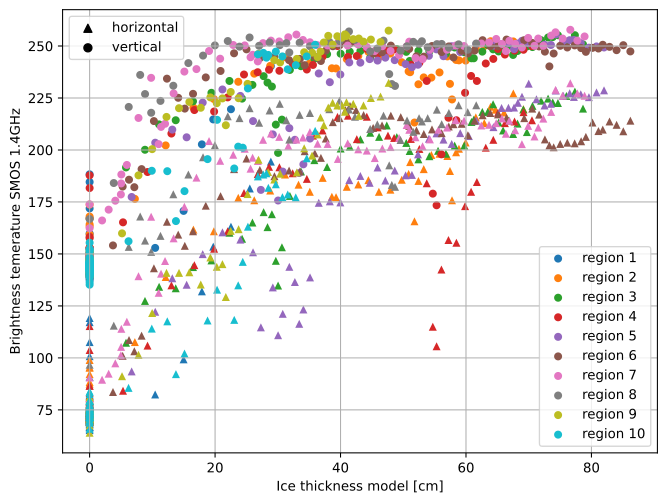
Fig. 1 Ice thickness to brightness temperature relation showing the original SMOS data for the three resions from [Huntemann et al., 2014] extracted at 53° incidence angle#
The Fig. 1 gives a nice relation beween ice thickness and the brightness temperatures in horizontal and vertical polarization. Horizontal shows a slower increase and later saturation but is subject to more noise in general. For the fitting procedure \(0\ \text{cm}\) ice thickness, i.e. open water, is excluded. The individual regions are shown in Fig. 2. The regions in Fig. 1 and Fig. 2 are corresponding according to their color. Most regions are located East to North-East of Novaya Zemlya in the Kara Sea but some regions are also located North-West of Novaya Zemlya in the Barents Sea.
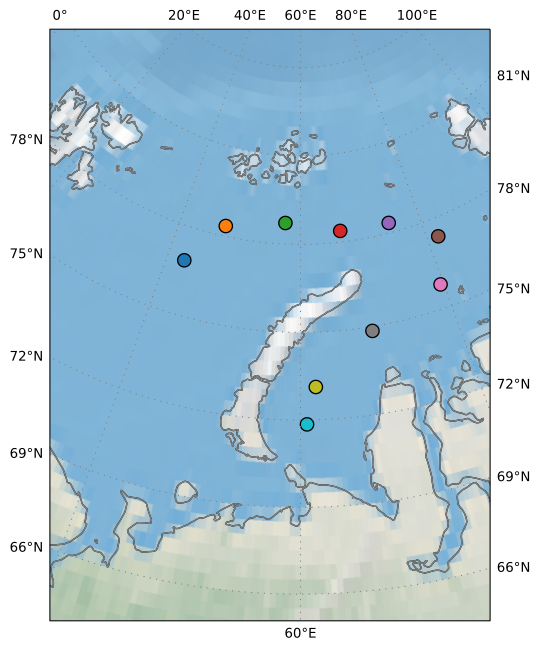
Fig. 2 Regions in the Kara and Barents Seas from the 2010 training data.#
Parameter estimation#
As a fit function a simple exponential is used with
where \(p_1\) is effectively the brightness temperature of open water close to sea ice under freezing conditions, \(p_2\) is the brightness temerature of thick sea ice, and \(p_3\) is a curvature parameter connecting the two TBs. The index \(p\) of \(f_p\) indicates the polarization, either \(h\) or \(v\).
The parameters \(p_i\) are optained in a fit to the data from the ten regions mentioned. A least square fit of equation (3) for \(T_{b,h}\) and \(T_{b,v}\) individually gives 6 parameters in total. The same can be done in intensity and polarization difference space while for polarization difference another fit formula is used
To compare the ice thickness to brightness temperature relation based on the new fit parameters, the original fit parameters have to be recalculated for the 53° incidence angle of CIMR. This gives 7 parameters for the recalculation of the original fit, with an additional parameter \(p_4\) for the polarization difference fit. The fit parameters are given in Table 1.
parameter |
\(p_1\) |
\(p_2\) |
\(p_3\) |
\(p_4\) |
|---|---|---|---|---|
horizontal \(T_{b,h}\) |
74.527 |
217.795 |
21.021 |
|
vertical \(T_{b,v}\) |
145.170 |
247.636 |
12.509 |
|
intensity \(I=(T_{b,v}+T_{b,h})/2\) |
109.891 |
231.596 |
16.829 |
|
polarization difference \(Q=(T_{b,v}-T_{b,h})\) |
71.086 |
34.322 |
38.731 |
2.142 |
Comparison between \(I-Q\) and \(h-v\) fit#
A resulting fit through all datapoints show that also the direct horizontal and vertical fits are suitable for representation of ice thickness to brightness temperature relation, similar to the orginally \(I-Q\) fit from [Huntemann et al., 2014]. Only slight divergence is seen in \(T_{b,h}\) at higher ice thickness. The fit parameters are given in Table 1.
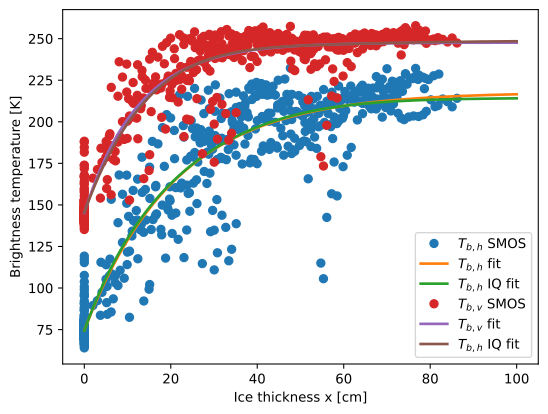
Fig. 3 Ice thickness to brightness temperature relation showing both fits \(T_{b,h}, T_{b,v}\) and \(I\), \(Q\)#
The relation for polarization difference, i.e. \(T_{b,v} - T_{b,h}\) to ice thickness, shows also good agreement with the data in both fit variants in Fig. 4. However, some differences are visible for thin ice and in the extrapolation to higher thicknesses. The increase of polarization difference after the initial freeze-up, between \(5\ \text{cm}\) and \(10\ \text{cm}\) ice thickness, seems physically plausible as calming of seawater results in smaller sea surface roughness and thus increased polarization difference. This is not captured by the \(I-Q\) fit functions as the (4) is constrained in this regard.
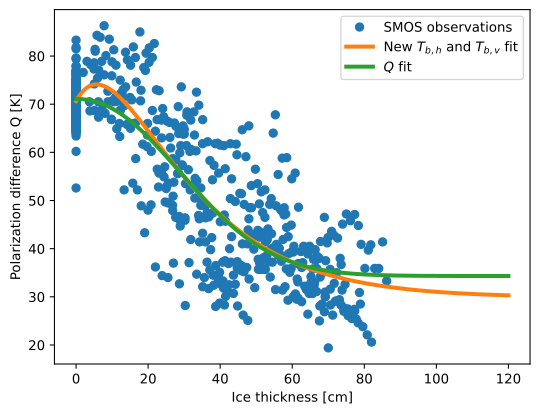
Fig. 4 Comparison fo fifunction in Q space between original Q fit and individual \(T_{b,h}\) and \(T_{b,v}\) fit#
The polarization difference plotted versus intensity, which is the original representation used by [Huntemann et al., 2014] and [Paţilea et al., 2019] also shows that the fit is appropriate in the \(I-Q\)-space in Fig. 5. The most notable difference is the same as in the Fig. 4 figure, i.e. the increase of polarization difference after the initial freeze-up, in the 5-10 cm regime. The highest ice thickness displayed here is 120 cm, which is a extrapolation for the current fit and comes with an extra uncertainty.
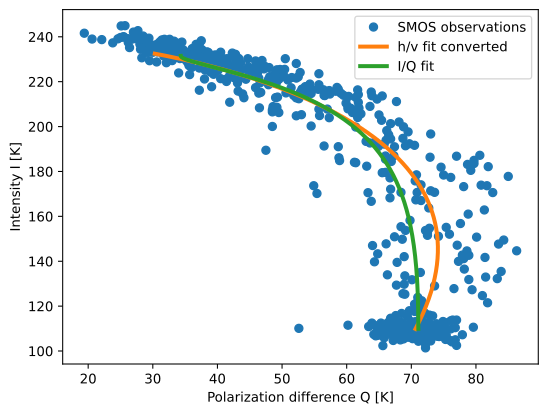
Fig. 5 Comparison of fit function in \(I-Q\)-space#